Dental implants, as a mature oral restoration method, have entered ordinary households. Medically speaking, a simple dental implant is just a minor surgery. With adequate preoperative preparation, a single tooth can be implanted in a few minutes. However, many elderly people face significantly increased implant difficulty and risks due to long-term tooth loss, multiple missing teeth, alveolar bone atrophy, and other factors. In addition, the elderly often suffer from various systemic diseases such as hypertension, coronary heart disease, cerebral thrombosis, and diabetes. Therefore, dental implant treatment must be carried out with extreme caution. To achieve an optimal treatment plan and outcomes, the expertise of a professional implant team, combined with scientific and rigorous evaluation and diagnosis, is essential.
1. New Concepts of Digital Implant Technology
Dental implants have been widely used in clinical practice since the 1980s. With the continuous development and advancement of oral restoration technology, oral implant technology has emerged as a promising and cutting-edge treatment option, providing patients with an excellent solution for tooth loss. Hailed as the first choice for missing tooth restoration, dental implants have earned the reputation of being “humanity’s third set of teeth.” Thus, oral implant technology boasts broad development prospects and significant promotional value.
Minimally Invasive Implantation
Advances in technology, the development and refinement of computer-aided implant design software, and the introduction of advanced equipment from various brands have enabled the complete resolution of conditions that previously required major surgery through minimally invasive procedures.
The evolution of modern oral implantology has progressed from edentulous jaw implantation to implantation for multiple and single missing teeth; from conventional delayed implantation (with 3–6 months of healing after tooth extraction) to early implantation (with 4–8 weeks of socket healing) and immediate implantation performed concurrently with tooth extraction; from two-stage implant surgery (stage one: implant placement; stage two: implant exposure) to one-stage surgery completed in a single visit; and from implant restoration performed 4–6 months after osseointegration to immediate temporary restoration on the same day of implant placement, also known as immediate restoration or immediate loading. As implant technology continues to mature, the concept of minimally invasive implantation—aimed at simplifying treatment procedures, shortening treatment duration, reducing the number of surgical interventions, and minimizing patient discomfort—has become an inevitable trend in the development of oral implant technology.
One-Stage Implantation Technology
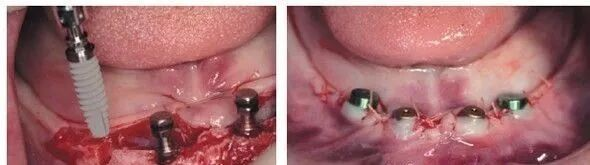
Currently, one-stage implant surgery is employed in over 80% of routine implant cases. This technique involves placing the implant and then directly attaching a gingival healing abutment that is exposed in the oral cavity. (See image below)
Flapless Implant Surgery Concept and Technology
Flapless implant surgery is not a blind procedure; it is based on accurate diagnosis and precise treatment planning, with implant placement performed under precise navigation. This technique places higher demands on the clinician’s expertise.
Accurate preoperative evaluation of the soft and hard tissues in the implant area is a prerequisite for flapless implant surgery. Cone-beam computed tomography (CBCT) of the oral and maxillofacial region enables three-dimensional assessment of alveolar bone anatomy, critical anatomical structures, bone quality, and bone volume. It helps clinicians accurately determine the width and height of the jawbone, as well as the positions of the inferior alveolar nerve and maxillary sinus floor, allowing for the optimal selection of implant position, angle, number, diameter, and length.
All-on-4 Implant Restoration Concept
The All-on-4 implant restoration concept is designed for edentulous patients with severe alveolar bone atrophy. It maximizes the use of residual bone volume by placing the minimum number of implants in the shortest time, enabling patients to receive fixed dentures or implant-supported overdentures.
Specially designed implants and their components (e.g., angled abutments) are the key to the All-on-4 concept and technology. To ensure that the most posterior implants emerge as close to the distal end of the jaw as possible and minimize the length of the prosthetic cantilever, implants in the maxilla are placed at an angle along the anterior wall of the maxillary sinus, while those in the mandible are angled to bypass the mental foramen and the anterior loop of the inferior alveolar nerve. This approach fully utilizes residual alveolar bone, increases implant length and bone contact area, eliminates the need for bone grafting, reduces surgical trauma, enables immediate restoration, and maximally eliminates or shortens the post-implant tooth loss period for patients.
This technique reduces surgical time, trauma, and anesthesia duration, lowering the inherent risks of surgery. Therefore, it is particularly suitable for elderly patients. (See image below)
2. Basic Process of Digital Implantation
The basic process of digital implantation integrates surgical and restorative information, helping clinicians achieve a high degree of consistency between the final implant restoration outcome and preoperative expectations.
As illustrated in Figure 2, the basic process of digital implantation incorporates a digital workflow into the traditional implant procedure:
- Clinical Examination
In addition to basic intraoral examination, clinicians should provide patients with a detailed explanation of the significance, process, and costs of digital implantation. Based on examination findings, further steps include intraoral impression taking and fabrication of radiographic dentures.
2.Data Collection
CBCT scanning is mandatory for patients undergoing digital implantation. For certain cases, CBCT scans are taken with the patient wearing radiographic dentures.
3.Treatment Planning
Specialized implant design software is used to perform three-dimensional reconstruction of CBCT data, facilitating the formulation of a detailed implant treatment plan.